01
Work visually with industrial data
Organise work as Notebook → Section → Page. Add live blocks, typed asset models and relationships such as FEEDS, CONTROLS and MEASURES.
CANVAS + GRAPH + CONTEXTUNS Navigator is the working layer above your namespace — a self-hosted canvas where plant data becomes dashboards, explainable alerts, forecasts, a knowledge graph and data products an AI can call.
NO CLOUD ACCOUNT · NO PHONE-HOME · READS YOUR PLANT, NEVER CONTROLS IT
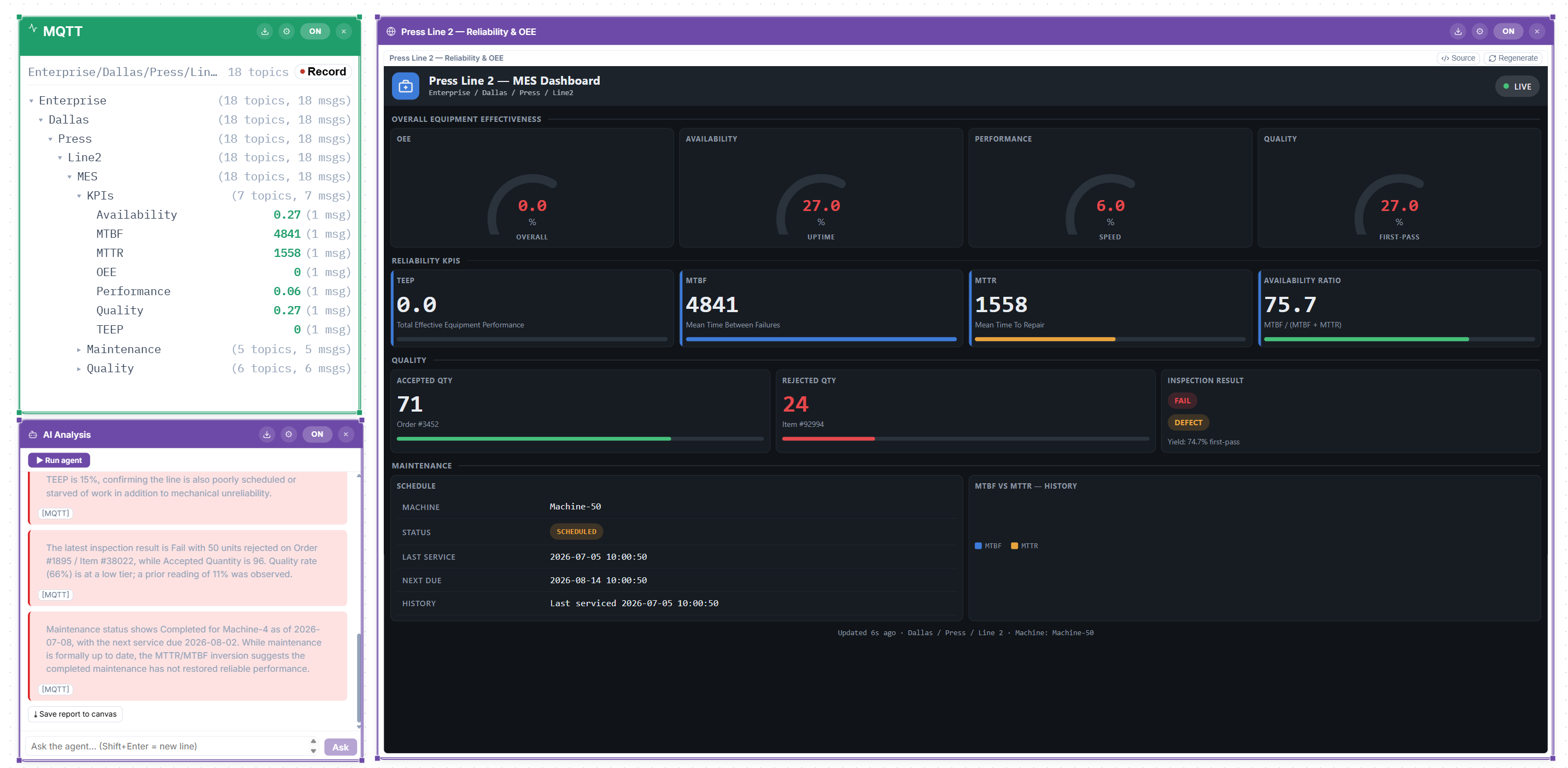
The broker is up. Topics are structured. Data is flowing. Then the layer above the namespace turns into another custom build: a dashboard nobody maintains, a reporting project that takes a quarter, or a data lake that answers questions nobody asked.
The data is available and still nobody is using it, because available and usable are different problems.
Place a source, query, register, machine, camera or document. Wire it. What you build is simultaneously a dashboard, a data-flow definition and the exact context an AI reasons over.
Organise work as Notebook → Section → Page. Add live blocks, typed asset models and relationships such as FEEDS, CONTROLS and MEASURES.
CANVAS + GRAPH + CONTEXTRead MQTT, OPC-UA, SQL, Modbus, Open Protocol, CFX, Hermes, REST, watched folders, cameras and serial machines through TCP bridges.
READ-ONLY CONNECTORSExpose a pipeline result over REST and, with one checkbox, as a scoped MCP tool an AI assistant can call directly.
ONE RESULT · TWO TRANSPORTSAn agent reads a block only when it is enabled, configured and in scope. Each gate can narrow context, never widen it. Reports identify the blocks used and cite them for factual claims.
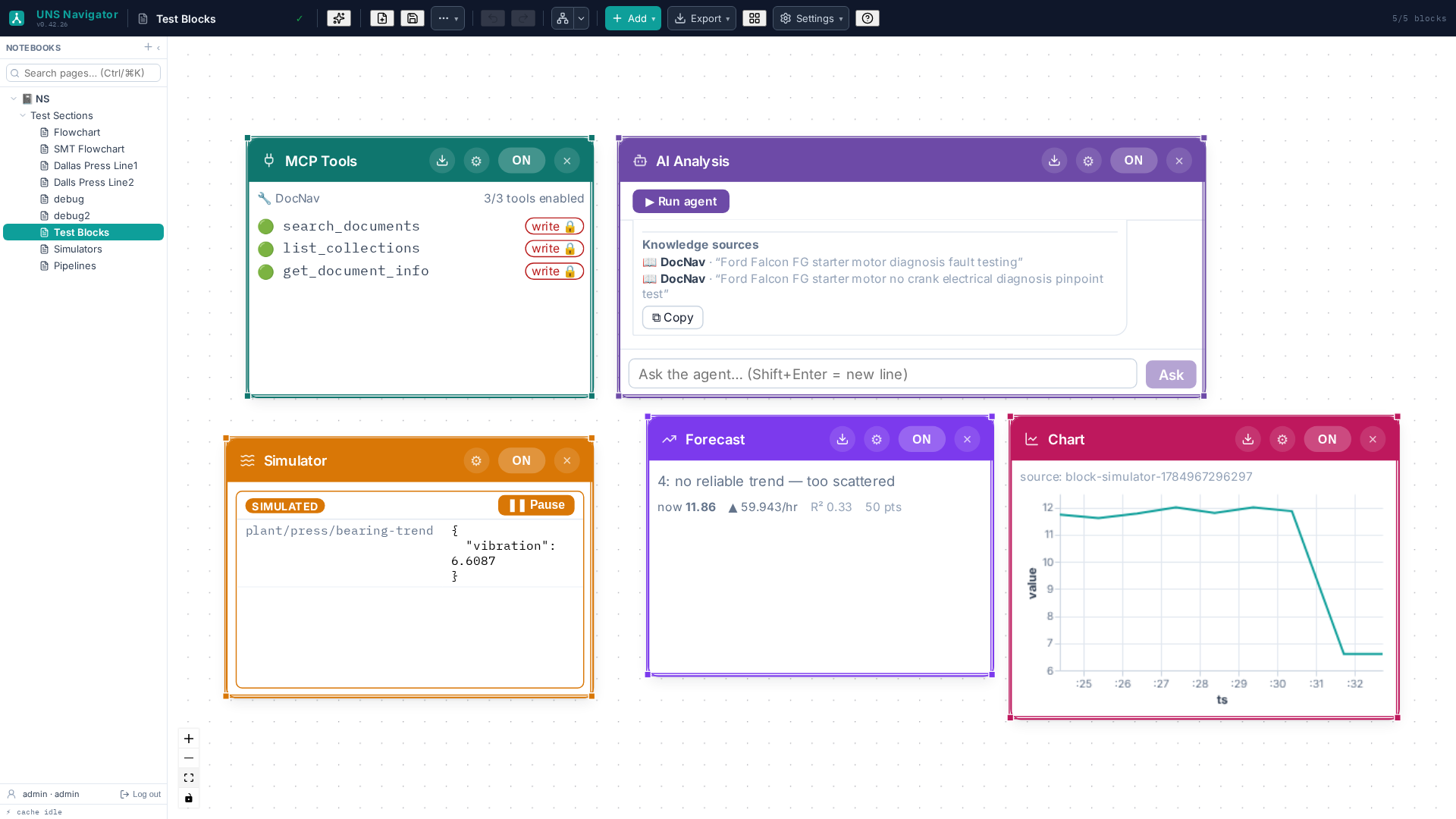
Typed, versioned pipelines run on manual, scheduled, streaming or event triggers. Dry-run traces every step and stubs every sink. Exposed results carry provenance and honest freshness.
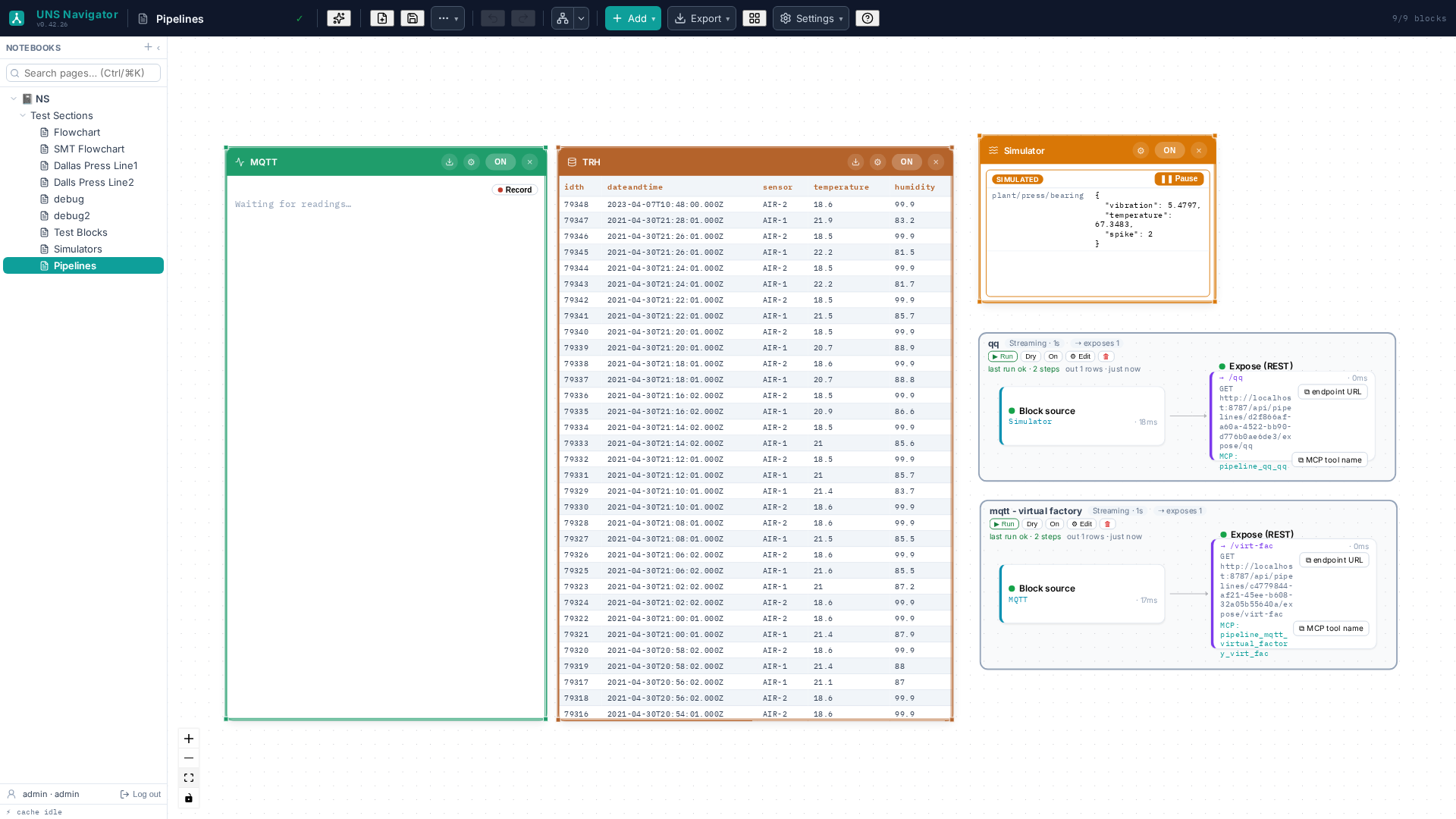
Anomaly detection reports the method, field, value and threshold that fired. Forecasting projects when a signal will cross a target — and refuses to invent a time when the trend is noisy, flat or heading the wrong way.
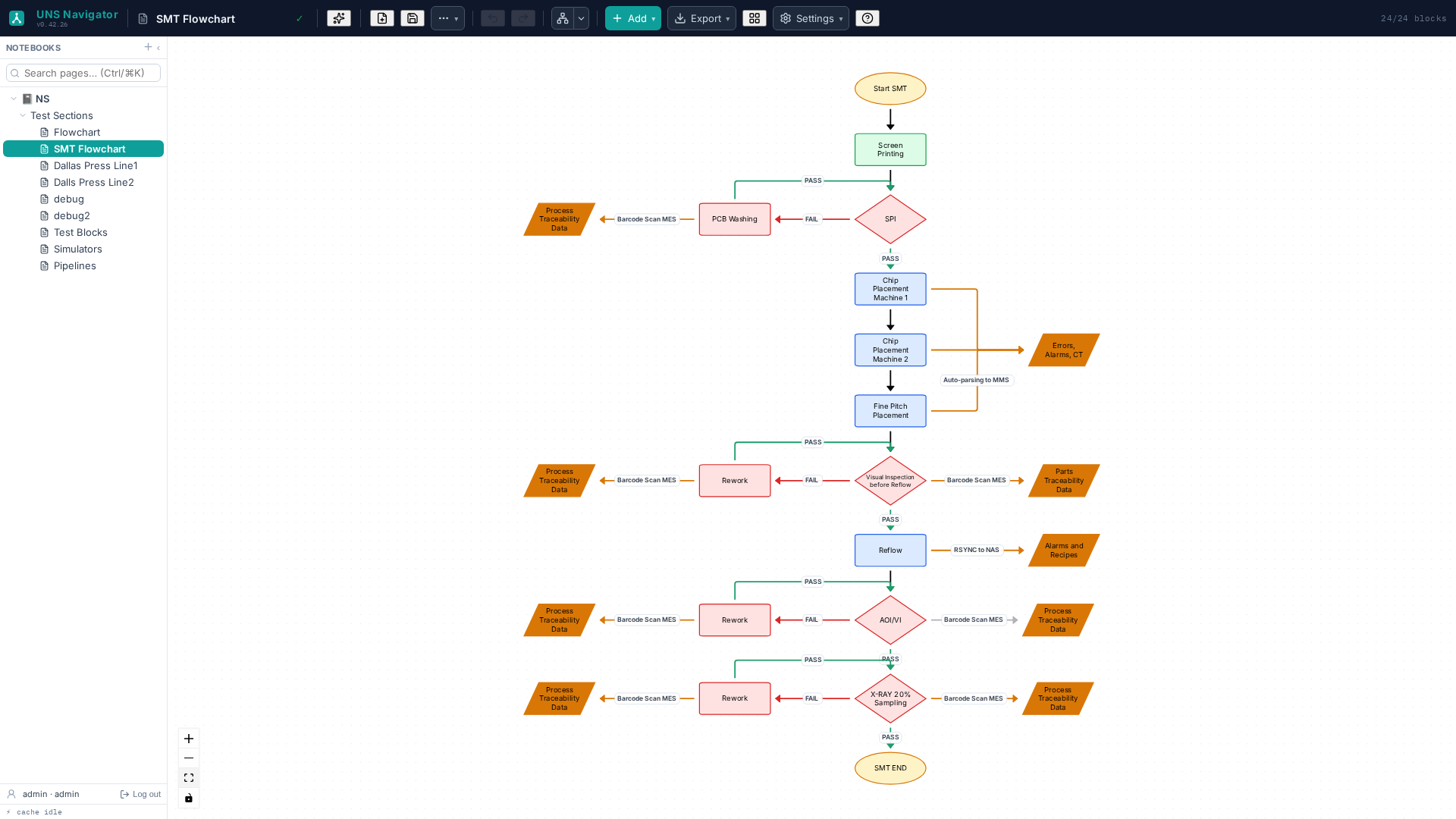
UNS Navigator carries plant context from the raw signal through to the operator surface, the knowledge behind it and the systems that consume the result.
Define an asset type once, bind each field to MQTT, OPC-UA, Modbus, SQL or a static source, then reuse the same apps and detectors across instances. Opt selected sources into TimescaleDB history with retention, compression, rollups and safe pruning.
Turn the namespace into a graph of typed relationships and operator notes. Feed it an SOP, Online Work Instruction or machine manual and it proposes reviewable knowledge with page-and-sentence citations. A person accepts every addition.
Generate live dashboard apps from a curated page, collect them in an App Hub and run a fullscreen Present rotation for control-room screens. Standalone exports use revocable read-only capability tokens.
Sign in with local accounts, Windows / Active Directory or Microsoft Entra. Viewer roles are enforced server-side, while separate audit and activity logs show deliberate actions and live system behaviour.
UNS Navigator is designed to be additive. It reads existing systems and keeps every deliberate egress path short, named and test-pinned.
One container, with optional TimescaleDB history and FalkorDB graph services. No cloud account, no phone-home and no network requirement for licensing.
Verified on x86-64 and ARM64, including single-board hardware suitable for a cabinet-level deployment.
No key, account or internet connection. Every feature is available for evaluation. If the trial ends, the workspace becomes read-only rather than bricking: pages, models and history remain viewable and exportable, and already-deployed apps keep serving.
No. It connects to yours. The built-in simulator can also generate realistic streams when no broker or plant connection is available.
No. It reads them and provides the working layer above. History is available as an opt-in TimescaleDB service per source.
No. Plant-facing source connectors are read-only. Deliberate egress paths are narrow, named and opt-in: MQTT publish, its own history tables and notification webhooks. It has no PLC or equipment command path.
A block must be enabled, configured and inside the agent's scope. The report lists the exact blocks it used. Local inference through Ollama is supported.
Yes. Give the knowledge graph an uploaded document, a watched file or rows from a document database. It proposes relationships and notes with page-and-sentence citations, and a person accepts or rejects each one.
An exposed pipeline result can become a read-only MCP tool, allowing an external AI assistant to query curated plant results without direct access to the source system.
Yes. Microsoft Entra sign-in sits alongside local accounts and Windows / Active Directory. Viewer permissions are enforced by the server.
A Docker-capable host. UNS Navigator is verified on x86-64 and ARM64, including single-board hardware for line-level or cabinet deployments.